
30-day training course for adult men
Take Back Control. Build Confidence. Start Your 30‑Day Journey.
A practical, self-paced educational program designed to help you better understand your body’s responses, practice control techniques, and build a more confident approach to intimacy.
Built on clinical guidelines and published research, with clear guidance on when to see a clinician.
- One short lesson and one practice each day, 10–20 minutes
- The complete course as one phone-friendly PDF
- Private and self-paced: no account, no subscription
One-time payment of $67.00 USD · No subscription
Thirty days describes the learning schedule, not a guaranteed timeline for results. Educational content only—not medical advice, diagnosis, or treatment.

Common questions about men’s sexual-health information
- “Where do I even start?”
- “Which advice is evidence-based?”
- “Who can I ask?”
- “Is there a clear plan?”
The approach
Clear information. One step at a time.
Ejaculation control is rarely taught in a structured way. This course organizes clinical guidelines and published research into a daily training path, and points to professional care where it belongs.
- 01The course
4 skills
Notice, pause, settle and stay present: taught in order, then combined
- 02The course
30 days
of short daily lessons. A learning schedule, not an outcome timeline
- 03The evidence
28 sources
clinical guidelines, reviews and trials, cited where they’re used
Who it’s for. And who it isn’t.
The same thirty days work from three very different starting points. Here’s where each one begins, and when to talk to a doctor first.
Starting point
It’s always been this way
For someone whose control has felt unreliable since his first experiences, and who wants a structured, private way to train it.
Where to beginDay 1 as written. A clinician can add options at any point.
Starting point
Something changed
For someone whose control changed after years of being satisfied. A change is worth a medical conversation, because erection problems, prostate inflammation, thyroid problems or stress can be involved.
Where to beginA clinician appointment first or alongside, then Day 1.
Starting point
Mostly the worry
For someone whose timing may be in a typical range but who feels the pressure and watches himself. Clinicians see this as common, normal variation.
Where to beginDay 1, with extra attention to Phase 03.
It’s for you if
- You want a structured, private way to build ejaculation control, based on published research.
- You’d rather understand why each technique may help.
- You can give it about 10–20 minutes a day.
- You want honest expectations and clear guidance on when to see a professional.
It’s not for you if
- You want a pill, a spray or an overnight fix.
- You want a guaranteed number of minutes. Nobody honest can promise that.
- Your concern is taking too long, or not finishing. This course isn’t designed for that.
- You’re under 18.
See a doctor first
Talk to a doctor before you start, or alongside the course, if any of these apply. A check-up isn’t a detour from the course; it’s part of it.
- A difficulty that started recently or is getting worse
- Trouble getting or keeping an erection most of the time
- Pain in the penis, testicles, pelvis or lower back, or pain when you ejaculate
- Blood in urine or semen, burning, or changes in how you urinate
- A change that began with a new or changed medicine
- Low mood or anxiety that goes beyond sex
Never stop a prescribed medicine on your own
Four skills. One daily plan.
Control is a skill, and the course teaches it in four parts. Each is explained with sources, practiced in short sessions, and then combined into one routine.
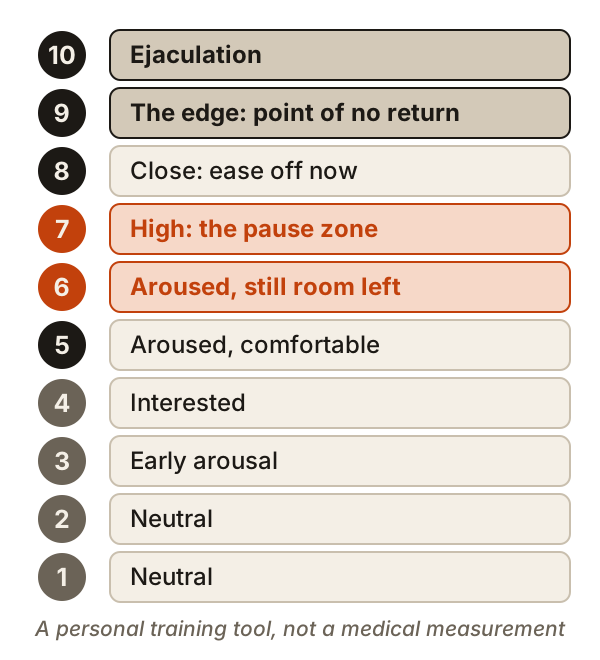
Skill IDays 01–09
Phase 01 · Understand your body
Notice
Catch the rise before the edge.
A personal 1–10 arousal scale and body-signal awareness. Clinicians designed stop-start to help men recognize mid-level arousal, so noticing comes before any technique (ISSM guideline).
What you practice
- Your own scale, with your own body cues
- A six-minute body scan
- Rating arousal in real time, without trying to delay
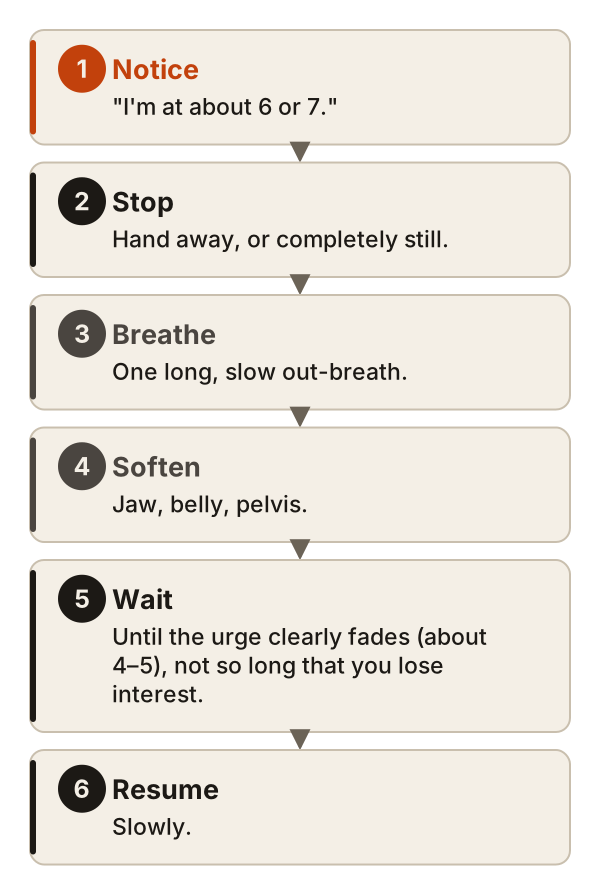
Skill IIDays 08–14
Phase 02 · Develop control
Pause or slow
Ease off at 6–7, then start again.
The stop-start technique in graded steps, then slowing down instead of stopping. Behavioral techniques have modest, limited evidence, and the course says so plainly.
What you practice
- Three-cycle stop-start sessions
- Slow, don’t stop
- The squeeze technique, as an option
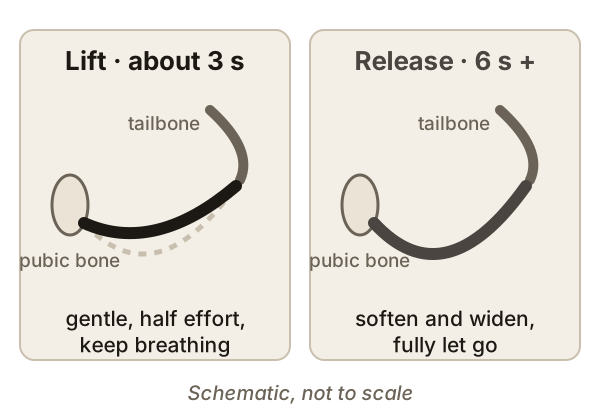
Skill IIIDays 06–14
Phase 01 · Phase 02
Settle
Long out-breath. Soft belly and pelvis.
Slow belly breathing and pelvic-floor release. Many men brace without knowing it. Release comes first, and gentle lifts only where they suit you, because overdoing them can increase tension (Cleveland Clinic).
What you practice
- 4-in, 6-out belly breathing
- The 3-breath reset
- Find, lift and fully release
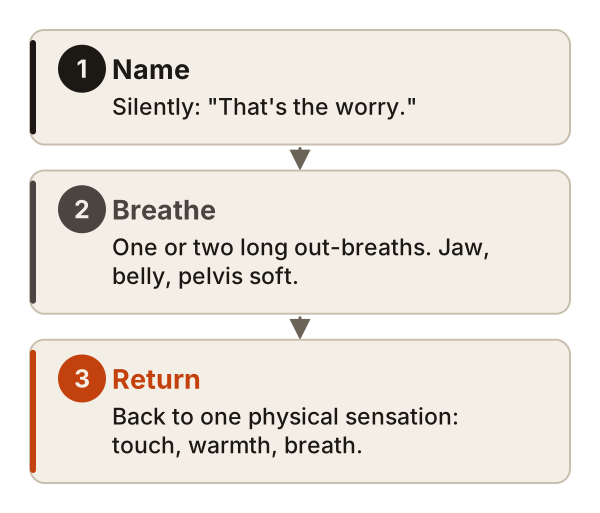
Skill IVDays 15–21
Phase 03 · Build confidence
Stay present
Less pressure. Less self-watching.
Performance anxiety affects an estimated 9–25% of men and contributes to early ejaculation (Pyke, 2020). The lessons cover the anxiety loop, self-talk, attention, erection worries and talking with a partner.
What you practice
- Name, Breathe, Return
- Rewriting harsh self-talk
- Wide attention: not distraction, not monitoring
The research behind the lessons.
The lessons draw on clinical guidelines and published studies. Here are four of them: what they found, how they were done, and where their limits are. None of them tested this course.
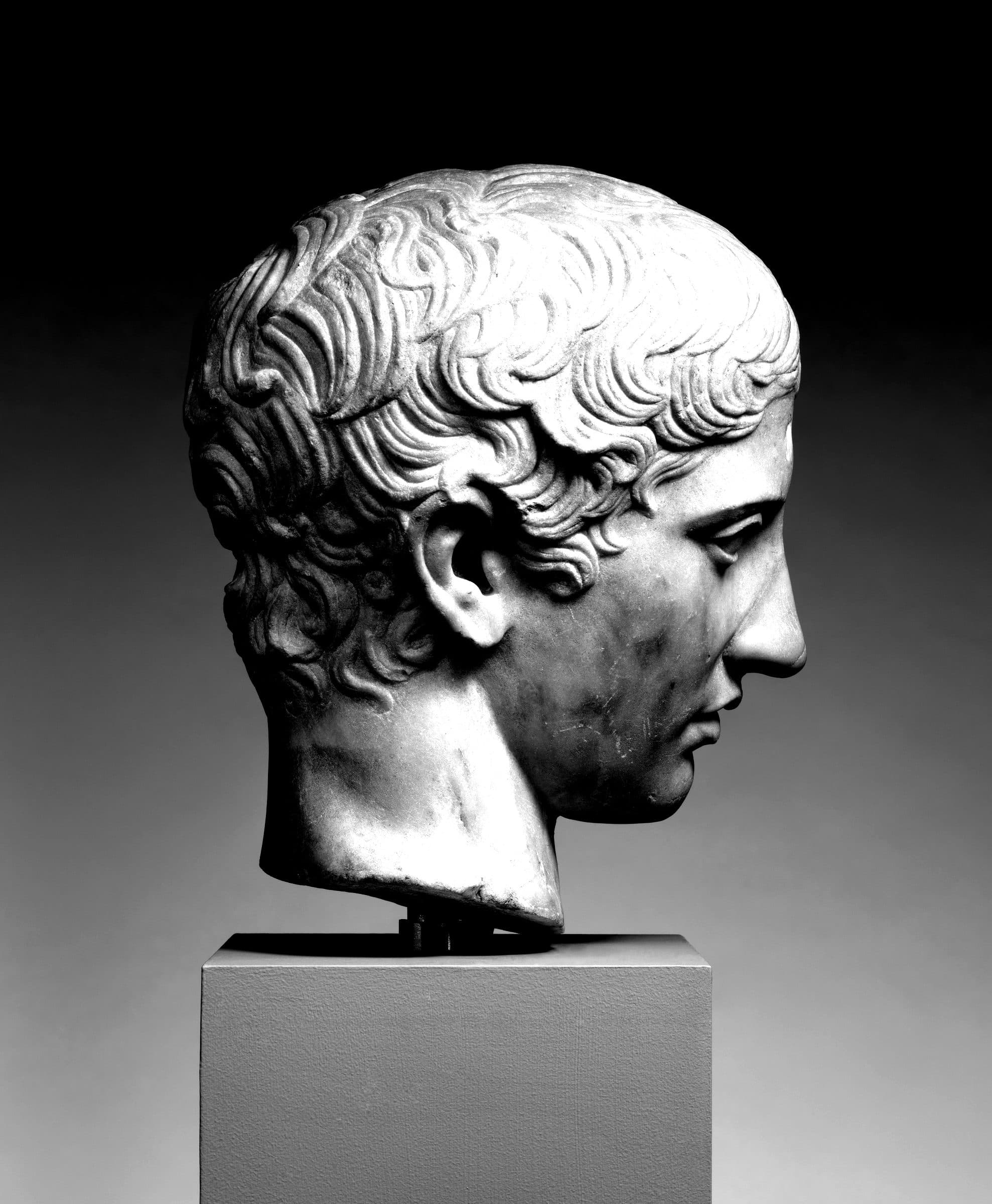
Proportion study · Polykleitos type
File 01· Randomized trial· 50 men· 6 weeks
6 wk
of home stop-start practice reduced symptoms, compared with a waiting list.
Wk 1Wk 2Wk 3Wk 4Wk 5Wk 6Illustration · 3 a week asked for · about 2 done on average
Men practiced stop-start at home, asked to do three sessions a week. Symptoms dropped with large effect sizes and no side effects were reported, even though they averaged about two sessions a week.
LimitOne small trial, using a purpose-made vibrating device. Gains held at 3 and 6 months, but few men answered follow-up.
Ventus et al., Archives of Sexual Behavior, 2020 (opens PubMed in a new tab)File 02· Survey· 1,463 women· 3 countries
47.6%
of women named his lack of attention and focus on performance as a source of distress, ahead of the short time.
His lack of attention, focus on performance47.6%
The short time39.9%
The lack of control24.1%
Women in Mexico, Italy and South Korea were asked what caused distress around early ejaculation. Inattention and a focus on performance came first (47.6%); the short time came second (39.9%).
LimitAn online panel survey of women in relationships with men. It describes perceptions, not causes, and partners differ.
Burri et al., Journal of Sexual Medicine, 2014 (opens PubMed in a new tab)File 03· Population survey· 500 couples· 5 countries
5.4 min
was the middle value in a stopwatch study of 500 couples. There is no single normal.
0.5 minmiddle 5.444 min Couples timed intercourse with a stopwatch for four weeks. Times ran from about half a minute to 44 minutes, and the middle value fell with age.
LimitHeterosexual couples and vaginal intercourse only. It describes variation; it is not a target, and the course doesn't use a stopwatch.
Waldinger et al., Journal of Sexual Medicine, 2005 (opens PubMed in a new tab)File 04· Systematic review· 521 men· 2015
10 trials
of behavioral techniques reviewed: real, but limited, evidence.
0102030405060708091010 trials · 521 men · evidence: limited
Stop-start, squeeze, sensate focus and pelvic-floor approaches were compared with waiting lists and medication. Some improved timing and satisfaction, and behavioral plus drug treatment beat drug treatment alone.
LimitSmall trials with unclear risk of bias. Guidelines call the evidence modest, which is why the course recommends medical care alongside it where needed.
Cooper et al., Sexual Medicine, 2015 (opens PubMed in a new tab)
These are findings from specific published studies, not results of this course and not promises about it. Studies differ from home practice, and results vary between individuals.
Cut the head off the myths.
Plenty of popular advice doesn’t hold up against the evidence. Here are four common examples.

A. Canova · Perseus, detail · 1804—06
Myth 01Under review
Myth: Just think about something else.The truth
It may delay things briefly for some men, but it pulls attention away from the body signals that give you warning. In one study, more frequent and more anxious non-erotic thoughts during sex went with poorer sexual functioning. The course teaches present attention instead.
Purdon & Watson, Archives of Sexual Behavior, 2011 (opens in a new tab)Myth 02Under review
Myth: Clench hard at the last second.The truth
Ejaculation is a reflex with two phases. By the time it feels unstoppable, the course’s view is that clenching mostly adds tension. Stop-start was designed to work earlier, by recognizing mid-level arousal during the build-up.
ISSM guideline (Althof et al., Sexual Medicine, 2014) (opens in a new tab)Myth 03Under review
Myth: “Enhancement” pills and sprays bought online are a safe shortcut.The truth
The FDA keeps a running list of sexual-enhancement products found to contain hidden drug ingredients. In its words: “These products pose a serious health risk and are not guaranteed to work.” Prescription options exist; a clinician can say whether any suit you.
U.S. Food and Drug Administration (opens in a new tab)Myth 04Under review
Myth: More Kegels are always better.The truth
Cleveland Clinic warns that overdoing them can increase muscle tension or worsen symptoms. For many men, learning to release the pelvic floor matters as much as squeezing it.
Cleveland Clinic (opens in a new tab)
4 myths0 survive
A. Canova · Perseus, detail · 1804—06
Thirty days. Four phases. One plan.
Each phase adds one skill on top of the last, and nothing advanced comes before its foundation. Days take about 10–20 minutes. Solo practice runs on no more than four days a week; the rest is reading, writing and breathing.
Days 01—07
Understand
Learn what actually happens in your body, and where control is possible. No technique yet.
≈ 10–15 min a day(est.)
Days 01—07 · no solo practice yet
- 01Mind
- 02Mind
- 03Mind
- 04Mind
- 05Opt.
- 06Body
- 07Review
Solo practiceOptionalBodyReview
- 01The lessonsYou Are Not Broken · What Actually Happens · Your Personal Patterns · The Arousal Scale
- 02Skill focusNotice: build a personal 1–10 scale with your own body cues
- 03PracticeAn optional first solo session on Day 5, noticing only
- 04Breath & bodyA six-minute body scan; 4-in, 6-out belly breathing
- 05MindFacts over shame: control matters more than minutes
- 06CheckpointDay 7 review and a readiness check before practice begins
4 phases30 days to learn itA maintenance plan to keep it
Thirty days describes the learning schedule, not a guaranteed timeline for results. Educational content only—not medical advice, diagnosis, or treatment.
Four phases. Nothing you don’t need.
Thirty daily lessons in four phases, plus the tools to keep going after Day 30. Delivered instantly as one phone-friendly PDF that you download and keep.
ContentsBasis
- 01
Understand your body
What happens from arousal to ejaculation, your personal patterns, the 1–10 scale, and breathing.
ISSM 2014 · Alwaal 2015
- 02
Develop control
Stop-start in graded steps, slowing instead of stopping, and pelvic-floor release.
Ventus 2020 · Cooper 2015
- 03
Build confidence
Performance anxiety, self-talk, attention, talking with a partner, and erection worries.
Pyke 2020 · Burri 2014
- 04
Apply and maintain
Real-life conditions, setbacks, when to get help, your own routine and a plan for after Day 30.
AUA/SMSNA 2022 · EAU 2026
- 05
Workbook tools
Baseline and final self-assessments, practice sheets, troubleshooting, FAQ, glossary and answer key.
28 sources
In every lesson
Objectives and why it matters
What you'll be able to do by the end, and how it connects to the next day.
The lesson, in plain language
What the research found, with sources you can check, and what it didn't.
Step-by-step practice
Clear instructions, a five-minute version for busy days, and an optional deeper one.
Common mistakes
What trips most men up, and how to correct it.
A worksheet and a knowledge check
Reflection, one line in your log, and two or three questions with an answer key.
Across the course
- Baseline & final self-assessment
- 30-day tracker
- Practice-session record
- Thought record
- Setback card
- Maintenance plan
- Quick-reference card
No supplements, devices or equipment to buy, and nothing graphic. Every lesson is educational, and the course is clear about when symptoms warrant professional assessment and that it does not replace prescribed treatment.
One PDF. Yours, privately.
Download it once and read it anywhere: on the train, in bed, on paper. Nobody else sees what you’re working on.
A
Instant download
The download link appears on the confirmation page as soon as your payment is confirmed, and a copy is sent to your email.
B
Made for your phone
One 330-page PDF sized for a phone screen, with a clickable contents page. It prints cleanly too, if you prefer paper.
C
Private by design
No account, no password, no newsletter, no app. Stripe handles payment, so card details never reach this site. Your log stays on your own device or paper.
D
At your own pace
About 10–20 minutes a day, with a five-minute version of every lesson. Miss a day and nothing resets. The file is yours to keep.
Answered plainly.
16 questions men ask before they start. No promises we can’t keep.
All16 questions
One clear plan. One payment.
No equipment, no supplements, nothing graphic. A typical day is a short lesson, one exercise and a line in your log. Tick through Day 1 to see the format, then start when you’re ready.
Day 1 of the course · Illustrative preview
Sample log · Illustrative preview
Day 1, previewed
0/4done
Total
≈ 19 minutes
Not Broken. Untrained.
The 30-day course
$67USD · One-time
What you get
- 30 daily lessons, about 10–20 minutes each
- The complete course as one phone-friendly PDF (330 pages)
- 21 diagrams, worksheets and a private log you keep yourself
- Knowledge checks with a full answer key
- A maintenance plan for after Day 30
- 28 sources, cited in the text
One-time payment of $67.00 USD · No subscription
Secure checkout by Stripe. Instant download. All sales are final (Refund Policy). Thirty days describes the learning schedule, not a guaranteed timeline for results. Educational content only—not medical advice, diagnosis, or treatment.